












.png)
.png)
The Holy Quran on Seas and Rivers
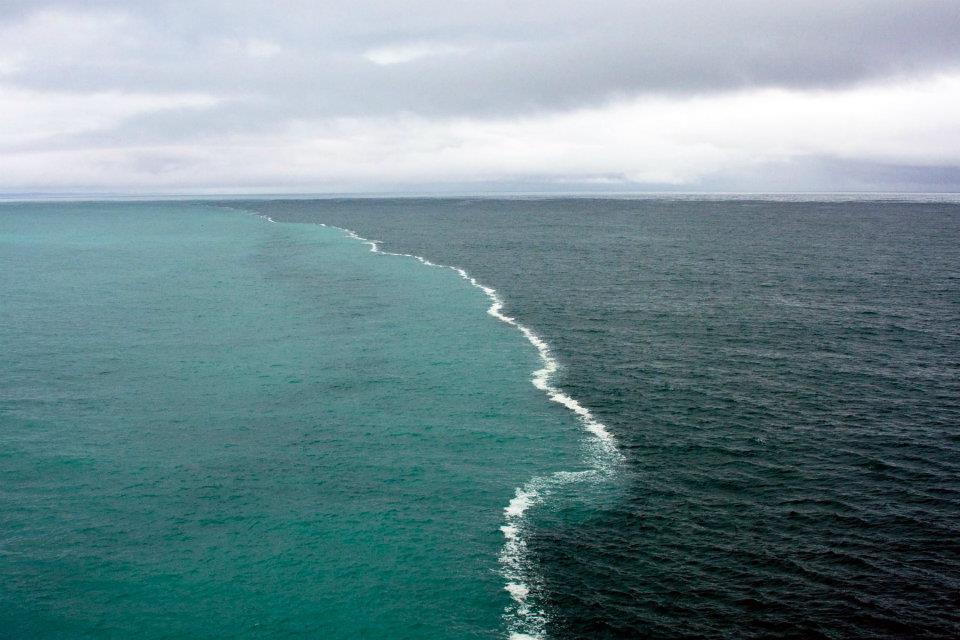
Modern Science has discovered that in the places where two different seas meet, there is a barrier between them. This barrier divides the two seas so that each sea has its own temperature, salinity, and density. For example, Mediterranean Sea water is warm, saline, and less dense, compared to Atlantic Ocean water. When Mediterranean Sea water enters the Atlantic over the Gibraltar sill, it moves several hundred kilometres into the Atlantic at a depth of about 1000 meters with its own warm, saline, and less dense characteristics. The Mediterranean water stabilizes at this depth.
The figure below shows the Mediterranean Sea water as it enters the Atlantic over the Gibraltar sill with its own warm, saline, and less dense characteristics, because of the barrier that distinguishes between them. Temperatures are in degrees Celsius (°C).
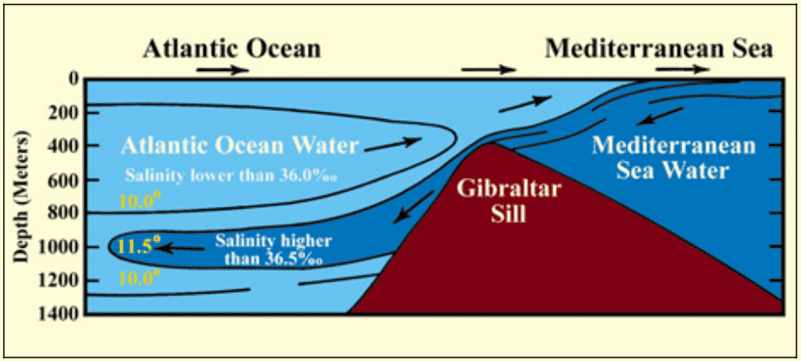
Although there are large waves, strong currents, and tides in these seas, they do not mix or transgress this barrier.
The Holy Qur’an mentioned that there is a barrier between two seas that meet and that they do not transgress. God has said:
He has set free the two seas meeting together. There is a barrier between them. They do not transgress. (Qur’an, 55:19-20)
But when the Qur’an speaks about the divider between fresh and salt water, it mentions the existence of “a forbidding partition” with the barrier. God has said in the Qur’an:
He is the one who has set free the two kinds of water, one sweet and palatable, and the other salty and bitter. And He has made between them a barrier and a forbidding partition. (Qur’an, 25:53)
One may ask, why did the Qur’an mention the partition when speaking about the divider between fresh and salt water, but did not mention it when speaking about the divider between the two seas?
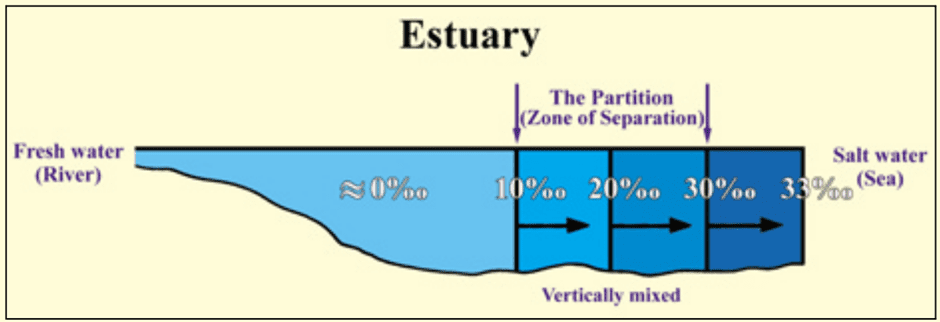
Modern science has discovered that in estuaries, where fresh (sweet) and salt water meet, the situation is somewhat different from what is found in places where two seas meet. It has been discovered that what distinguishes fresh water from salt water in estuaries is a “pycnocline zone with a marked density discontinuity separating the two layers.” This partition (zone of separation) has a different salinity from the fresh water and from the salt water. The figure below shows Longitudinal section showing salinity (parts per thousand ‰) in an estuary. We can see here the partition (zone of separation) between the fresh and the salt water.
This information has been discovered only recently, using advanced equipment to measure temperature, salinity, density, oxygen dissolubility, etc. The human eye cannot see the difference between the two seas that meet, rather the two seas appear to us as one homogeneous sea. Likewise, the human eye cannot see the division of water in estuaries into the three kinds: fresh water, salt water, and the partition (zone of separation).
References:
- Principles of Oceanography, Davis.
- Oceanography, Gross.
- Introductory Oceanography, Thurman.
Umar seo
More from Umar seo

Explanation of 'Aayat ul ...
9 Nov 2022
Benefits of Prayer – Why ...
10 Nov 2022
The Rights of Non-Muslims in ...
13 Oct 2022


